
The Importance of Core Engagement
Have you ever heard the words “engage your core” during a workout class and wondered what exactly does that mean? Are you engaging your core correctly, and what is happening within your body from a biomechanical perspective? Proper core engagement is essential for safe exercise, functional movement and lifelong mobility by stabilizing and protecting the spine, managing intra-abdominal pressure and reducing risk of injury. By understanding how to properly activate and engage the muscles of the core effectively, clients can develop a greater understanding and confidence in their movements inside and outside the studio.
What Makes Up the Core
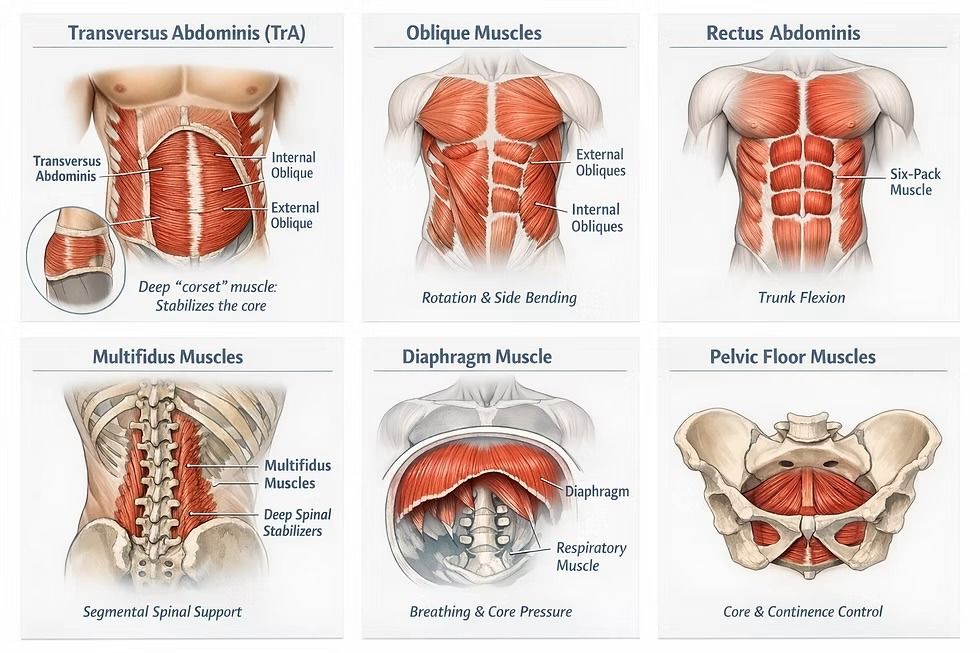
To understand how to properly engage your core, it’s important to first understand what muscles make up the core and how they work together. When clients first think of what the “core” is, the first muscle that likely comes to mind is the rectus abdominis, which is the prominent abdominal muscle along the front of the torso, when in reality the core is much more complex than a single muscle. It’s helpful to visualize the core as a three dimensional box that is composed of multiple layers of muscles that work synergistically to support and stabilize the spine, manage intra-abdominal pressure and support controlled movement patterns.
At the top of the core box is the diaphragm, while the pelvic floor muscles form the bottom of the box. Wrapping around the front and sides of the torso are the abdominal muscles, including the deepest layer, the transverse abdominis, followed by the internal and external obliques and most superficial rectus abdominis. The posterior aspect of the core includes the erector spinae muscles, multifidus, quadratus lumborum and gluteal muscles.
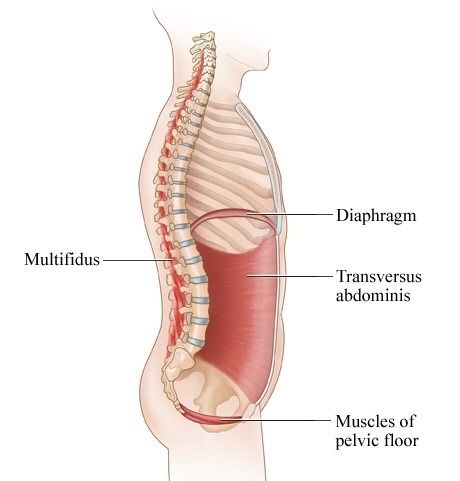
Together, these muscles work in conjunction with each other to provide support for the spine and pelvis as the rest of the body moves. Understanding how these muscles work together is key to learning how to engage the core effectively – not just by simply tightening the abdominal muscles or “bracing” the core, it requires coordinated muscle activation and proper breath control with awareness to neutral spine positioning. The breath serves as the key connection to the core.
How to Properly Engage the Core
When you take a breath in, the lungs fill with air creating expansion through the front, back and sides of the ribcage. As the diaphragm contracts and moves downward, the pelvic floor muscles respond by lengthening and descending. These actions slightly increase intra-abdominal pressure which provides support to the spine in preparation for movement. When you take an intentional breath out through pursed lips, the pelvic floor muscles contract and raise, the transverse abdominis (also known as the “corset muscle”) creates a wrapping sensation as it contracts around the trunk to provide stability to the spine keeping intra-abdominal pressure stable, and the diaphragm lifts as air is expressed out of the lungs and eventually out the mouth.
Connecting the breath to our deep core muscles is essential for maintaining spinal stability during movement. This support is important in all types of movements, whether that movement is a set of single leg extensions in a mat pilates class, a bent over row in a strength class or a squat to pick up the grocery bags from the floor in everyday life. Each movement pattern has a unique breath coordination based on the intention of the exercise with the ultimate goal to promote proper core engagement for better stability, control and efficient movement. With the mastery of breath control, comes a deeper connection to the core leading to a happy spine and body that is supported during movement patterns in class and everyday life.
Proper Core Engagement Within Strength Training
During strength training sessions, the goal is to improve muscular strength through progressive overload by lifting a sufficient amount of weight to simulate physiological adaptations within the targeted muscle group. However, without proper form and core engagement, clients may increase their risk for injury. Relying on momentum rather than controlled movement and managing intra-abdominal pressure ineffectively can potentially lead to low back discomfort or other injuries.
One common exercise found within our strength classes at Niche includes variations of a squat utilizing strength training equipment such as dumbbells, kettle bells and the cable machine. In order to appropriately engage the core throughout a squat variation, start with the ribcage stacked over hips. Maintaining this proper alignment, inhale as the hips hinge and knees bend to lower the body into a squat position. As you exhale, focus on creating a gentle wrapping sensation around the trunk to activate the deep core muscles while keeping the rib to hip connection as the glutes and quads activate press the floor away allowing the body to rise from the squat. Throughout the movement, it is important to maintain alignment between the ribcage and hips. If the low back begins to arch excessively or the ribcage begins to flare, it may indicate a loss in core engagement, comprising spinal stability and increasing risk for discomfort or injury.
At Niche, clients have the ability to participate in group circuit style strength training classes or private personal training sessions working 1 on 1 with a Niche Strength Training Instructor that can personalize the strength training experience to the client’s goals and needs. As a client, there are many scenarios in which a private session can be beneficial to you. If you are new to the strength training space, a private session can give you a good baseline understanding and confidence on how to successfully complete movement patterns with proper form and core engagement. If you have a specific movement pattern that doesn’t feel quite right in class and you’re curious if you are doing the movement with proper form and core engagement, a private session can give you and your instructor the time to take a deeper dive into the movement and problem solve together. Or, maybe you’re just curious if your core is activating and working efficiently and effectively in order to get the most out of your exercise session and reduce risk of injury.
Every Movement is a Core Exercise
Every movement pattern, whether it’s a core focused exercise within a mat or reformer session, an upper body exercise with a set of heavy dumbbells in a strength class or a functional movement pattern that we do everyday like walking up stairs, requires appropriate core engagement to keep our bodies stable, supported and safe. By developing this skill and awareness, clients are building a strong foundation for lifelong movement success, both inside the studio and beyond.
Learn more about engaging your core in Taylor’s video below:
Work one-on-one with a Niche instructor to explore your movement, ask questions, and build a plan around your goals. Private personal training spots are available.
Book a private session here.